
How the Humble Duplex Can Help Solve a Housing Crisis | Columbus Monthly
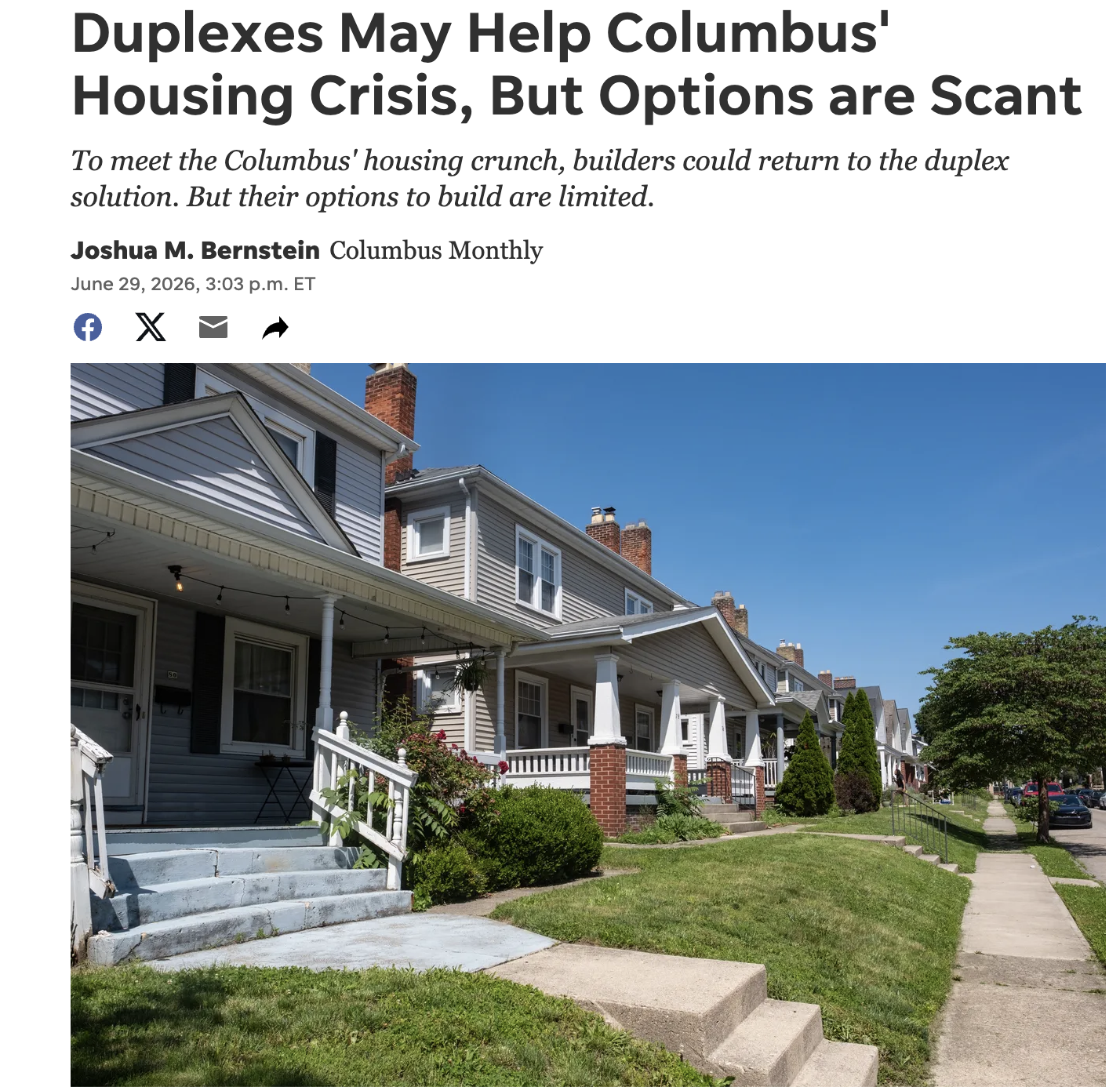
Growing up in Wadsworth, Ohio, an Akron suburb founded in 1814, Carlie Boos was typically a few steps from family. She lived in a duplex with her parents, and her cousins rented the connected next-door unit. Extra eyes came in handy. “I remember my mom banging on the neighbor’s door and saying, ‘I’ve got to run to the store. Keep an eye on Carlie,’” says Boos, executive director of the Affordable Housing Alliance of Central Ohio. “It was lovely, and it was family.”
Neighborly familial bonds are scarcer today. In and around Columbus, prewar duplexes—two independent dwelling units beneath one roof—and larger multifamily housing were integrated into older neighborhoods and municipalities including Victorian Village, Old North Columbus, Upper Arlington and Westerville, plus the capital’s urban core. But a 1954 zoning change prohibited multifamily housing across parts of Columbus. Policies rooted in racial discrimination prioritized single-family homes, and car-centric suburbs expanded outward, no need to share walls.
The region’s zoning laws allow duplexes on only 17 percent of all parcels, according to Twin Goals, a new AHACO study on building family wealth and affordability through duplexes. They’re prohibited or face discretionary or conditional approval in at least 79 percent of the region. “Governments put their thumb on the scale,” Boos says, driving a “nail in the coffin for middle-class housing.”
Solely building single-family homes exacerbates an acute housing shortage. Columbus has added 120,000 residents since 2010, and central Ohio’s population is projected to increase to 3 million by 2050 from 2.3 million, a boom spiking prices and threatening the region’s relative affordability. To relieve housing pressure, ease costs and keep up with growth, local governments are rewriting zoning codes to create more “missing middle” housing that sits between single-family homes and high-rise buildings—duplexes, triplexes, quadplexes and accessory dwelling units built in a homeowner’s backyard.
Call it gentle density. “We’re not talking about plopping an eight-story, 50-unit apartment building in a neighborhood,” says Belkis Schoenhals, a planning manager for the city of Columbus. “These types of housing seamlessly weave into a community,” she says.