
Bugging Out: Brewed Food Rewrites the Rules of Culinary Fermentation | Draft Magazine
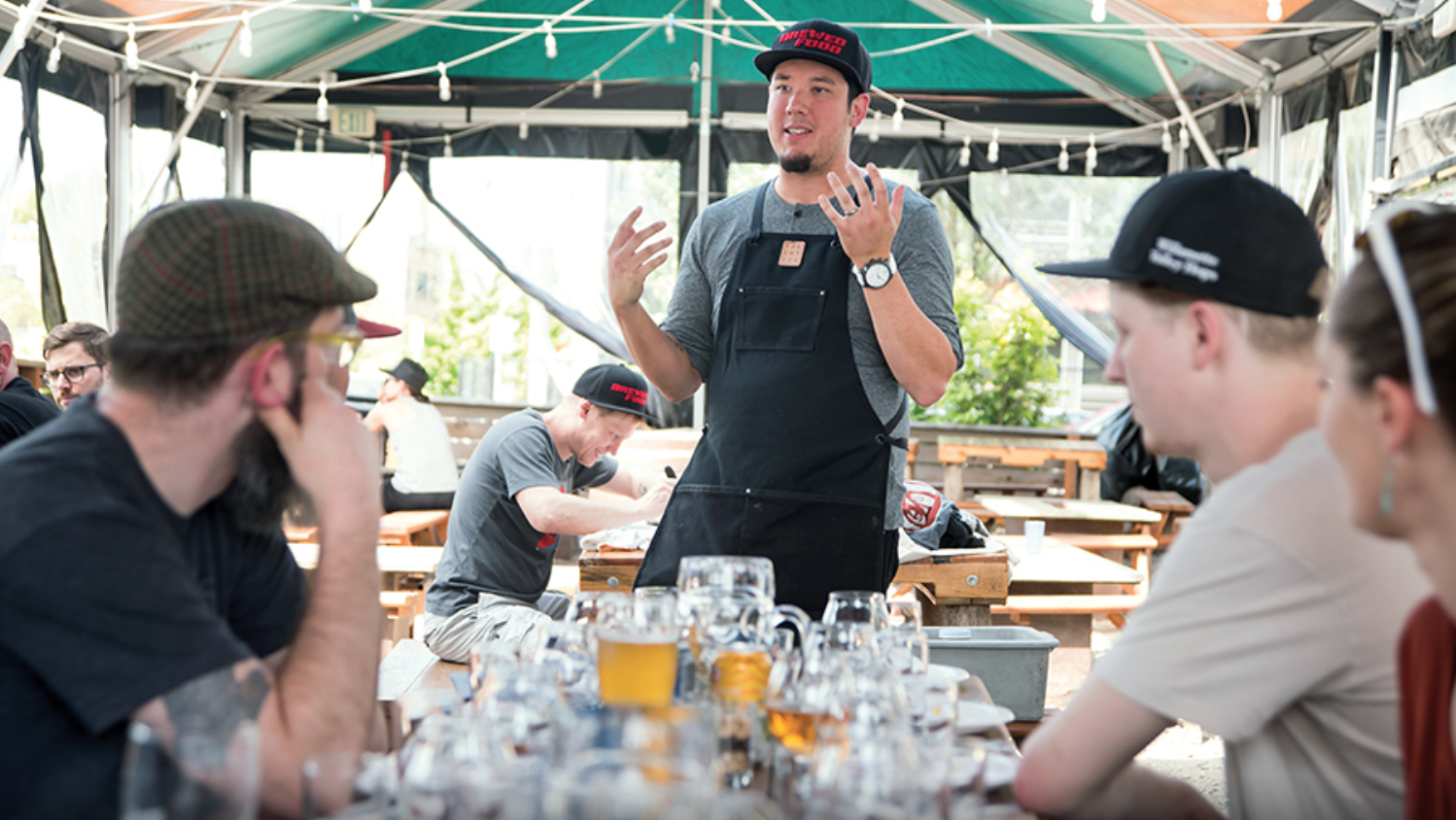
Photo by Casey Campbell Photography
For Draft magazine I profiled Jensen Cummings, a Denver chef that deploys brewing yeast to ferment his kimchi, hot sauces and so much more. He's broadening the concept of what beer and food can be.
***
Jensen Cummings favors a different set of ingredients than most chefs. He ferments yogurt with brewing yeast, adds crystal malt to sauerkraut, creates hop vinegar, and makes beef jerky with malt extract. It’s both a scientific and gastronomic endeavor to connect cooking and brewing, a concept and company that he calls Brewed Food.
“Our lens is looking at brewing techniques and ingredients as culinary ingredients,” Cummings says. “Yeast is the center of that conversation. We want to say that yeast is a culinary ingredient.”
Since founding Brewed Food in 2014, he has worked with a revolving cast of brewing collaborators, such as New Belgium and Jester King, and chefs to re-wire beer’s relationship to all things edible. The experimental ground zero is Cummings’ Denver test kitchen, where a large whiteboard is filled with fermentation fantasies, such as turning classic pairings like strawberries with black pepper into beer. “We’ll do a beer aged on strawberries with no black pepper. We want to coax out those pepper notes with a mixed culture or maybe some saison yeast,” he says.
Cummings and company will take any sugar source (honey, agave syrup, etc.) and ferment it with upward of fifty yeast strains to see which functions best. This technical work, done in conjunction with local yeast lab Inland Island, is Brewed Food’s biggest undertaking. There are books aplenty on brewing with yeast, but, as he explains, “We’re fermenting solid mediums, not liquid.”
He quickly learned the specific challenges during early attempts to convert cabbage into kimchi. “The plant matter just disintegrated,” Cummings says. “It tasted great, if you want a bowl of gruel. Many of our fermentations were epic failures of not understanding that sugar isn’t sugar and what fermentation activity would do to plant matter.”
Cummings’ fix is multiphase fermentation. The first couple weeks, while souring Lactobacillus bacteria does the heavy lifting, Cummings ferments yeast in sugar water. “We call that our MSG. It’s pure flavor,” he says. He then pours the mixture onto kimchi and adds additional yeast. “It’s like mounting a sauce with butter.”
The chef wasn’t always so crazy about beer, once crushing “dirty thirties” of Milwaukee’s Best. Cooking, though, is coded into his DNA. His family has been in the restaurant business for five generations. In Little Falls, Minnesota, his great-great grandfather ran La Fond House (“It looked like someplace where Wyatt Earp shot somebody out front, a straight-up corner saloon,” he says), and his great-grandfather and grandfather operated restaurants and bars in San Francisco. While Cumming’s dad “can’t boil an egg,” his father’s three younger brothers own restaurants in Ames, Iowa.
After barely graduating high school in San Diego, he learned the kitchen ropes at his uncle’s Ames sports bar and, in time, attended Des Moines Culinary Institute. His beverage teacher doubled as a general manager for the local Rock Bottom Restaurant and Brewery, which the students toured. “I had no concept there was a human being creating something with their hands,” he says of meeting the brewer.
He began educating his palate on global beers, falling in love with both New Belgium Fat Tire and his now-wife, Betsy. While Betsy finished college, Cummings moved to Kansas City to work at the influential 40 Sardines (since shuttered). At a Boulevard Brewing Co. beer dinner, he sampled an early version of Tank 7, a dry and fruity exultation of farmhouse perfection. “I was like, ‘This is what it needs to be about,’ creating something new, something interesting, something exciting that I’d never seen,” he says.
Brewery-drenched Denver was the couple’s next move. There, Cummings secured his Cicerone certification, worked as a restaurant group’s beer buyer, and brewed collaborative beers with Bull & Bush, “…trying any way I could to scratch and claw into a position where I could have a serious conversation about beer and food.”
He sought the connections between brewing and cooking, discovering a link: spent grain. That waste product could be repurposed as food, a bond between cooks of a different kind. Cummings’ insight sits at the core of Brewed Food. “The brewer is a chef and the brew house is a kitchen,” he says. In addition to raising two young sons, he takes Brewed Food on the road to restaurants and breweries such as Cincinnati’s Rhinegeist and Seattle’s Fremont and has a line of packaged goods, including soy sauce and kimchi. Under the Good Bugs mantle, he’s created collaborative beers with more than twenty breweries, including Crooked Stave, Trve, and Rhinegeist.
Fermentation’s serial thrills fuel Cummings’ trials as he forges new pathways for integrating beer and cuisine. “Brewed Food was built on the belief that beer and food—and, more importantly, brewing and cooking—can and should be the pinnacle of culinary experience,” he says. “That’s the sentence I look at and say, ‘Am I doing everything that I can to drive that home?’”