
The Birth of Long Island’s Beer Scene | Imbibe
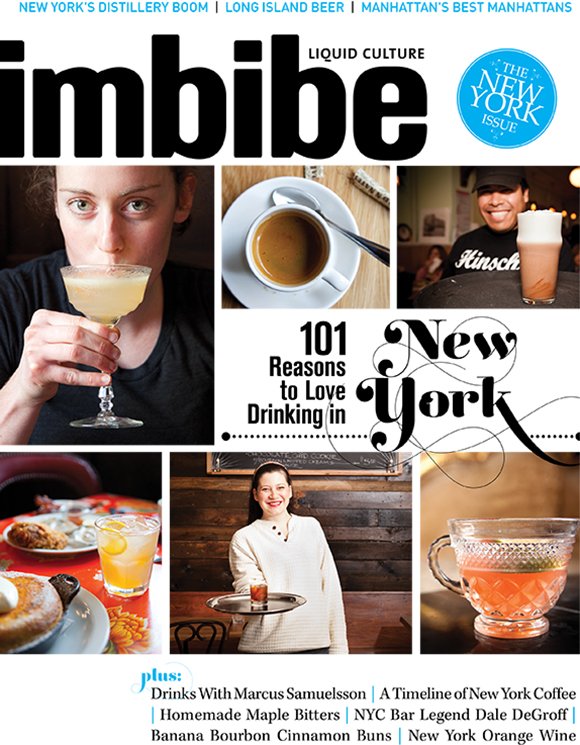
This article was published in 2012 in Imbibe.
In the summer of 2009, with a tropical rainstorm battering Long Island, my friend Aaron and I boarded an eastbound train from Brooklyn to Greenport, an end-of-the-line fishing village located on Long Island’s North Fork. Typically on weekends, the train teems with New Yorkers’ streaming to this Atlantic Ocean–lapped escape, a short ferry from the beaches of Shelter Island. Today’s train was a ghost town. But a little rain seemed fitting for our liquid voyage.
Upon arriving two hours later, we dashed through empty streets and ankle-deep puddles to a former firehouse. “Welcome to Greenport Harbor Brewing,” greeted the longhaired woman manning the tasting room. “You look like you need a beer.” She poured samples of the cocoa-touched Black Duck Porter, the caramel-nuanced Disorient IPA and the wheat-driven Harbor Ale. Who needed a beach or dry shoes to be happy? “Take your time drinking,” she said, gesturing to the fat raindrops sheeting onto the road. “You may be stuck on Long Island for a while.”
For lovers of craft beer, that would be a welcome sentence. In recent years, the biggest island in the contiguous United States—it stretches 118 miles, from New York Harbor to the eastern edge, encompassing Queens and Brooklyn—has become a brewing hotbed. More than a half dozen breweries and counting have sprouted to serve a massive underserved market: around 4 million people live on Long Island, with another 8 million in New York (counting Queens and Brooklyn). “Long Island is set up to be a great region for craft beer,” says Rick Sobotka, the founder and brewmaster of Great South Bay Brewery.
Long Island beers defy simple categorization. Blind Bat Brewing incorporates homegrown herbs and smoked malts in its rustic ales, while Great South Bay’s lineup includes the juniper berry–dosed Sleigh Ryed red ale and silky Snaggletooth Stout made with local apples, licorice and cinnamon. Paying homage to its aquatic location, Port Jeff Brewing Company turns out the Runaway Ferry Imperial IPA and lightly citrusy Schooner Ale. Long Ireland specializes in stouts and traditional Irish ales, while nanobrewery Barrier Brewing’s distinctive brews count the salty and sour Gosilla and the ruby-toned Vermillion Saison Rouge.
Better Late Than Never
Compared to the West Coast and even nearby New England, Long Island came late to craft beer. One contributing factor is the region’s scores of giant beach bars, which traffic in mass quantities of well-advertised mainstream beers. This creates “formidable competition for small breweries,” says Phil Markowski, the brewmaster at Southampton Publick House, who also notes the lasting legacy of lowbrow New York brands such as Schaefer and Rheingold. “People carried a mindset that if it was local, it couldn’t be good.”
Nonetheless, carbonated culture began bubbling during the early ’90s craft-beer craze, with beersmiths such as Cobblestone Brewery and Winery, Long Island Brewing Company and LongShore Brewery launching. Few, except for Patchogue’s Brickhouse Brewery, endured. “Many breweries started as get-rich-quick schemes,” says Mark Burford, 49, the head brewer at Patchogue’s Blue Point Brewing Company. After getting turned on to craft beer in California and working at the Honolulu Brewing Company, the Long Island native returned to open a homebrew-supply shop, later leaving to brew at the short-lived LIBC and Cobblestone breweries.
Committed to Long Island craft beer, he partnered with Peter Cotter, a former homebrew-shop customer, to launch Blue Point (the name references the area’s acclaimed oyster breed). The duo paid cut-rate prices for defunct breweries’ equipment, including a direct-fire brick brew kettle; white-hot flames impart a toasted profile to beer. They leased the old Penguin Ice factory, “maxed out our credit cards, jumped off a cliff and started brewing,” Burford recalls.
They took their Toasted Lager—born from the unique kettle—to bars for taste tests. “People thought we were crazy,” Burford recalls. Though customers were slow to switch, Burford and Potter were unwavering in their belied that Long Island was ready for craft beer. Our philosophy was, ‘We’re going to live at the brewery before we let it go down,’” Burford recalls. As years disappeared, Blue Point became a stalwart, with brands such as Hoptical Illusion and the robust Winter Ale serving as Long Islanders’ go-to brews.
Southampton Publick House traveled a different road to long-term sustainability. The brewery launched in 1996, a time when brewmaster Phil Markowski, 50, watched people “jump into the business because it was the hot thing to do.” To separate himself from fly-by-night operations, Markowski approached his craft with an artisan’s zeal. The brewpub’s first year, he freely experimented with barrel aging and making brews with wine grapes, and his German- and Belgian-leaning beers such as the subtly herbal Altbier, souped-up Double White witbier and complex, tropical Saison Deluxe soon won armloads of medals. “We endured because we were passionate about beer and brewing,” Markowski says.
However, passion could not overcome one hurdle: Southampton’s population swells during summer and shrinks during winter. To help survive the slow season, the brewery sold its beer in New York City. “It helped us survive the offseason,” Markowski says. “There’s an umbilical cord that attaches the Hamptons to New York City.”
Catching Hops Fever
For most of the millennium’s first decade, Blue Point and Southampton remained the only major breweries east of New York City. Around NYC, the brewing scene wasn’t much better. In Brooklyn, Sixpoint and Greenpoint Beer Works (makers of Kelso and Heartland beer) joined Brooklyn Brewery, while Chelsea Brewing made suds in Manhattan and Captain Lawrence brewed in Pleasantville, just north of NYC. That’s precious few production breweries for such a dense region.
Blame partly goes to real estate. Stratospheric rents mean that few start-ups can afford the square footage to brew in NYC. “The number of breweries the metropolitan area can have is limited by space,” says Long Island Pulse’s Niko Krommydas, 27. “Long Island has an opportunity to fill that void.” That’s why the last several years have welcomed Long Island breweries with twin agendas: To make proudly local brews for Long Island, while also exporting beer to the Big Apple.
Initially, that was not the plan for John Liegey, 48, and Rich Vandenburgh, 49, the founders of Greenport Harbor. The college friends were more attracted to Greenport’s seafaring location near farms and wineries than proximity to Manhattan, more than two hours west. In 2008, they purchased a dilapidated firehouse and commenced its rehabilitation. “People were like, ‘Why are those two guys hanging on top of a roofless building swinging hammers?’ ” Liegey recalls. When the brewery opened in summer 2009, serving the British-inspired beers of DJ Swanson (a veteran of Long Island’s respected John Harvard’s Brew House), curiosity turned to devotion. “The city embraced us,” Liegey says, with locals and tourists jamming the tasting room and even the mayor queuing for growler fills.
Vacationers returned to Brooklyn and Manhattan with word of Greenport beer, and that first fall, distributors began courting the brewery. By March 2010, they signed a deal to supply NYC. “Rich and I look at each other and say, ‘Holy, cow, I did not imagine this,’ ” Liegey says. To meet demand, they’re building a new production and bottling facility, which will not be in Greenport. They’re still committed to the town, though, with the firehouse remaining as the innovative, experimental brewery. “We’re as much about being a brewery as we are about being a Greenport brewery,” he says.
On the other hand, Rick Sobotka’s Great South Bay is the local brewery of Bay Shore. “When I was 20, I started thinking about opening a brewery wherever I ended up,” says Sobotka, now 41, who grew up in upstate New York. After the lifelong homebrewer completed his anesthesiology residency he nearly took an anesthesiology job in Port Jefferson. Instead, a better medical job presented itself in Bay Shore, located in the mouth of Great South Bay in Long Island’s south shore.
Two years after taking his job, in 2009, the anesthesiologist began laying Great South Bay’s groundwork. He spent a grueling year and a half researching sites. Though less costly than New York City, “land and buildings in Long Island aren’t cheap,” he says. “For less money, I could open a brewery in upstate New York, but I wouldn’t have 4 million people to sell beer to immediately.” Eventually, he found an ideal location—his home, hospital and surgical center where he works are within a mile and a half radius—and poured his first pints of Massive IPA and Blonde Ambition ale on September 10, 2011.
Within the first year, Sobotka sold his beer in around 200 venues. “That’s three times what I predicted,” he says, with residents flocking for growler fills and merchandise. “If it’s born and bred in Long Island, people love to incorporate it into their lives,” Sobotka says. “As much beer as we put out, we can sell.” That’s why Great South Bay is increasing capacity—Sobotka anticipates entering the metropolitan market by mid-2012—adding a canning line and carving out space for sour-beer experiments and barrel aging. “Long Island is wide open for innovative beers,” Sobotka says.
Currently, some of Long Island’s smallest breweries make the quirkiest beer. At Oceanside’s Barrier Brewing, a nanobrewery headquartered in a 1,000-square-foot industrial space, Evan Klein, 31, and Craig Frymark, 28, craft nearly 30 different styles of beer, a remarkable output from a single-barrel system. “We took this limiting situation and made it an advantage,” says brewer and distributor Frymark. “A bar can offer customers a different Barrier beer almost every time.”
This demands a taxing schedule. On Monday, Wednesday and Friday, the twosome brews four times, spending Tuesday and Thursday self-distributing beers to Long Island and, largely, Manhattan and Brooklyn. It makes sense, since Frymark and Klein, the latter a native of nearby Long Beach, previously worked at Brooklyn’s Sixpoint. But make no bones about it: Barrier was a brewery born of Klein’s intention of bringing great beer to Long Island: “Evan opened this brewery in his backyard because, in his mind, there was no good beer being made anywhere nearby,” Frymark says.
For Paul Dlugokencky, 52, Blind Bat Brewing’s nearsighted, color-blind brewmaster, the notion of place is central to his brewing philosophy. Operating from a three-barrel brewery in his detached garage in Centerport, on the north shore, Dlugokencky relies on basil, coriander and potatoes his organic-gardener wife has grown, or malt he hand-smoked to create idiosyncratic ales. “I make beers that I want to drink,” says Dlugokencky of brews such as the Old Walt Smoked Wit, Vlad the Inhaler (a recreation of Poland’s smoked wheat ale Grodziskie) and both the Long Island Potato and Oyster Stout. While his brewing career is relegated to nights and weekends—his day job is at the American Institute of Physics publishing group—Dlugokencky still takes time to sell his hand-bottled wares at a nearby farmers’ market. In addition, he self-distributes at bottle shops on Long Island and, naturally, New York City. “It’s a terrific market on the island, with the bonus of being close to Brooklyn, Queens and Manhattan,” says Dlugokencky.
Drink to the Island’s Health
A beer scene’s vital signs should not be measured on brewery numbers alone. Also key is knowledgeably staffed beer bars and stores, thriving homebrew clubs and festivals. “A big reason why beer drinker are becoming more passionate is the Starfish Junction festivals,” says Krommydas. Annually, Starfish produces the International Great Beer Expo, North Fork Craft Beer, BBQ and Wine Festival, Spring Craft Beer Festival and the Blue Point Cask Ale Festival.
When the cask fest commenced in 2005, it was held during winter in a lightly heated tent in Blue Point’s parking lot. “People would trek in wearing snowshoes and ski in,” Burford recalls, laughing. (The festival is now in April.) For attendees, it “gave them a sense of camaraderie.” That’s due to the festival’s inclusive nature. Beside area breweries, attendees can sample casks from long-running homebrew clubs Long Island Beer & Malt Enthusiasts and Brewer’s East End Revival, which was established in 1996.
Beyond homebrew, shops such as Shoreline Beverage and Bellport Cold Beer & Soda are large supporters of Long Island beer, which can be found at a growing collection of craft-focused bars, including Smithtown’s 52-draft Tap & Barrel “microbrew pub” and Mineola’s 25-tap Black Sheep Ale House. “When I started in November 2009, I had a hard time finding bars that had decent beer,” Krommydas says. “Now, I don’t have enough arms to cover every place that serves craft beer, makes craft beer or wants to make craft beer.”
There’s plenty more in the pipeline. Late last year, Spider Bite Brewing started distributing First Bite Pale Ale and Boris the Spider Russian Imperial Stout. Barrage Brewing and Rocky Point Artisan Brewers will hopefully be licensed and brewing this year, with Ghost Cat Brewing close behind. In addition, Barrier Brewing is relocating to a larger, five-barrel brewing facility, and Blind Bat’s Dlugokencky hopes to open a seven-barrel brewery on a plot of farmland, where his wife can plant larger crops.
Blue Point, too, is expanding, but it’s with a heavy heart. Demand has outstripped capacity, and the brewery must find a new location outside Patchogue. “People ask us, ‘Why didn’t you think about this 13 years ago?’ I tell them, ‘We were just trying to get a batch of beer out there,’ ” Burford says. It’s a problem, he says, but it’s a good problem to have. In Long Island, “local pride is so strong right now. The future is going to be the brightest part of craft beer.”