
This article was published in the Oregonian in 2011.
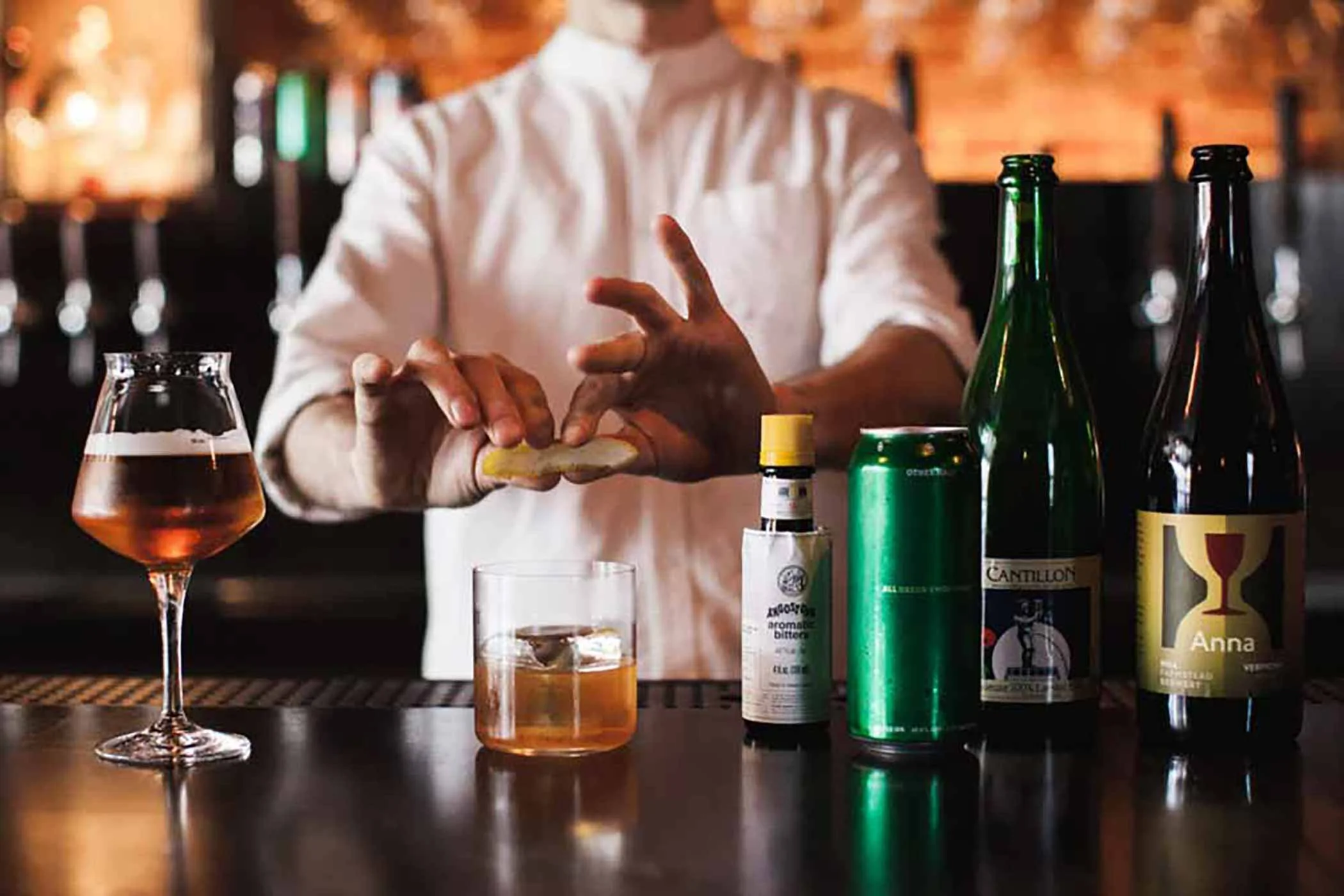
In Portland, the line dividing beer and spirits has grown blurrier than my eyesight after a double IPA. Thanks to events like Brewing Up Cocktails, as well as mixed-drink meccas such as Beaker & Flask and Clyde Common, beer-spirit cocktails have gone from carbonated curiosities to menu standbys. But some breweries don’t see the need for an after-market liquor addition. Armed with malts, hops, herbs, oak barrels and outside-the-keg ingenuity, Rose City brewers are creating cocktail beers—not beer-based cocktails, mind you—and even sudsy liquor facsimiles untouched by the hard stuff. Let’s call it a spirit of innovation.
***
Earlier this year, Jacob Grier, Metrovino’s mixologist and Brewing Up Cocktails cofounder (along with Hop & Vine owner Yetta Vorobik and writer Ezra Johnson-Greenough), faced a conundrum: As a rep for Bols Genever, he was uncertain how to best introduce Portland to the category-defying Dutch spirit. Made from a malty distillate composed of rye, corn and wheat, genever is infused with botanicals such as juniper berries, anise seed and hops—the aromatic offspring of whiskey, gin and beer.
Grier turned to Bols’ U.S. brand director for advice on how genever is consumed in Holland. “They drink it as a beer and a shot,” he replied. “It’s called the kopstootje.” Translated to “little headbutt,” the kopstootje consists of topping a tulip-shape glass with genever. Drinkers slurp it hands-free, trying not to “headbutt” the glass. After the first nip, imbibers leisurely sip the genever, alternating with a light lager—hardly Portland’s preferred beer.
To find the ideal Bols-paired brew, Grier sought out Alex Ganum at Upright Brewing, which focuses on herb-laden farmhouse beers. “We jumped on it right away,” Ganum says. “It’s something that seemed right up our alley.” After seeing genever’s list of botanicals, including anise seed, ginger, angelica and licorice, “I noticed flavors that related to a bière de garde,” Ganum says of the strong, rustic French beer that can be brewed with an ale or lager yeast. (A bière de garde is not necessarily dosed with botanicals.) Made with lager yeast, his rich, delicately spiced Kopstootje Biere was the spirit’s carbonated mirror image. “People liked the similarity of the Bols and the beer,” Ganum says of the beer, which he hopes to re-create next year.
Giving beer a liquor profile is hardly terra incognita, especially when you consider that whiskey is distilled from wash—essentially, un-hopped beer. In fact, Widmer Brothers supplies the wash for Clear Creek Distillery’s McCarthy’s Oregon Single Malt Whiskey. In addition, Rogue Ales uses the grain blend for its Dead Guy Ale to create the Dead Guy Whiskey. Turning this concept on its head, some brewers are bypassing distillation and skipping straight ahead to creating cocktail-based beers. Brooklyn Brewery’s Manhattan Project evoked the Mad Men favorite, while its Concoction referenced the Scotch-and-ginger Penicillin drink. Seattle’s Naked City Brewery used oak cubes soaked in Kahlúa to craft the White Russian Imperial Cream Stout. And this March, Breakside Brewery’s head brewer, Ben Edmunds, collaborated with Brewing Up Cocktails to create a trio of cocktail beers: a Sazerac, a Bramble and a Whiskey Ginger based on Beaker & Flask’s fruity, potent Six Lengths Ahead. “You have to choose your cocktail wisely,” Edmunds says. “You can’t just conjure up a mojito beer; it’s difficult to replicate those light flavors of rum or soda.”
To start, Edmunds brewed a lightly hoppy ale that tipped the scales at 5 percent ABV. In Portland, it’s the sort of beer that makes a small splash. Though “the beer on its own might not taste all that great on its own, it’s just one component,” Edmunds explains. “You have to change the mentality of how your finished beer should taste.” Next, Edmunds set out building each beer’s cocktail flavor. Since a Sazerac contains rye whiskey, absinthe, Peychaud’s bitters and lemon peel, Edmunds dumped the beer into a used Ransom WhipperSnapper Whiskey barrel, added citrus, star anise (to mimic absinthe) and…how much bitters? “Our calculations came out that we needed something like 48 bottles of Peychaud’s,” says Edmunds, who scaled back his bitters addition. The gin-and-fruit Bramble proved easier to approximate. Edmunds mixed the beer with blackberry purée and lemon peel and let it slumber in a Ransom Old Tom Gin barrel. It imparted a botanical flavor that was amped up with crushed juniper berries. The results were as divergent as they were delicious. If you tasted the Bramble and Sazerac side-by-side “you’d never know they were the same beer,” Edmunds says.
This project merely whet Edmunds’ appetite for cocktail-beer experimentation. For his take on the gin-driven Tom Collins, he pumped his Rye Kölsch through a Randall—a device for infusing flavors into beer—stuffed with juniper berries and cucumbers. He mixes his sour German gose with a spicy chelada mix, resulting in a genre-leaping, border-hopping bloody beer. (You’ll find a different take from Michigan’s Short’s Brewing, which makes the Bloody Beer.) And he’s currently concepting a recipe for a bourbon barrel–aged imperial porter inspired by Teardrop Lounge’s Hunter’s Moon cocktail, which contains rye, Cointreau-glazed marshmallows and bittersweet chocolate syrup.
Naturally, such experimentation risks alienating customers, especially when crossing the hallowed cocktail–craft beer divide. “When some people ordered our Sazerac, they thought they were getting a cocktail, and other people that wanted a beer were disappointed when they got the Sazerac,” Edmunds explains. “Some purists want beer to be beer.” Edmunds understands that there’s a learning curve. Given a little education, perhaps drinkers will soon raise a pint glass and get in the spirit.